Knossos Palace
The ancient palace complex at the heart of Minoan civilisation, Knossos is a must-visit — controversial reconstructions and all. Allow at least a half-day and go early.
No trip to Crete is complete without Knossos. The palace complex dates back more than three and a half thousand years and was the ceremonial and political centre of the Minoan civilisation — the first advanced culture in Europe. At its peak it housed thousands of people across a labyrinthine network of rooms, courtyards, and storage chambers, and the myths it inspired, including the legend of the Minotaur and the labyrinth, have echoed through Western culture ever since.
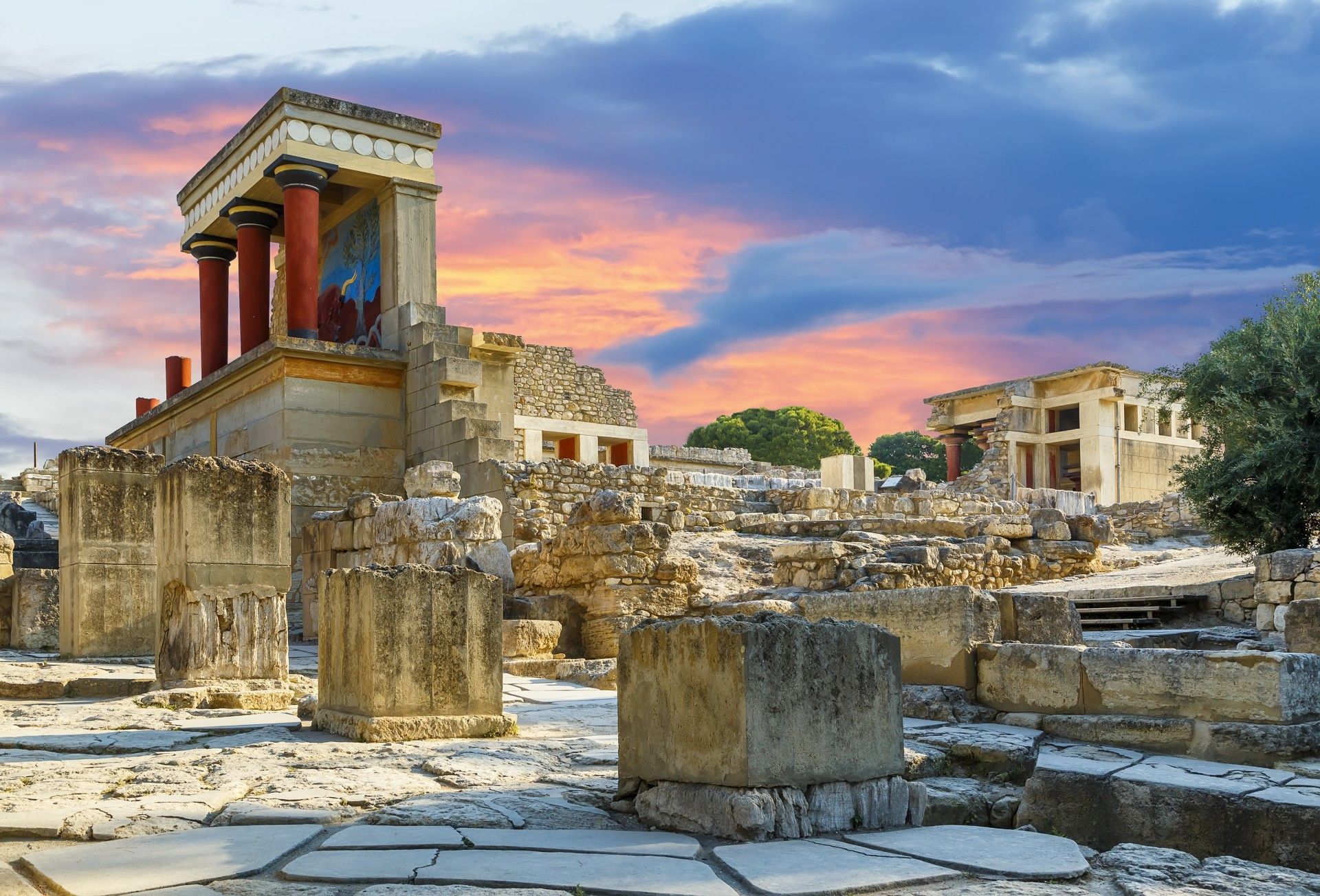
The site was excavated and substantially reconstructed by British archaeologist Arthur Evans in the early twentieth century, and his interpretations remain controversial among scholars. The concrete restorations and vivid painted reproductions divide opinion — some find them helpful, others jarring — but they do give a sense of scale and colour that a field of bare ruins rarely can.
Go early to beat the heat and the tour groups, and consider hiring a guide or picking up an audio tour — the site is large and context makes a significant difference. The Heraklion Archaeological Museum, which houses the original frescoes and artefacts from the site, is worth pairing with a visit on the same day.
Where the labyrinth began
Knossos is the largest Bronze Age archaeological site on Crete and the center most closely tied to the myth of the Labyrinth. Its ruined palace complex became one of the defining symbols of Minoan civilization and still shapes how visitors imagine ancient Crete.
Location
Knossos, Heraklion, Crete, 71409
Contact
+30 2810 231940
Email
Hours
Monday
8:00am - 8:00pm
Tuesday
8:00am - 8:00pm
Wednesday
8:00am - 8:00pm
Thursday
8:00am - 8:00pm
Friday
8:00am - 8:00pm
Saturday
8:00am - 8:00pm
Sunday
8:00am - 8:00pm

© 2026 Apollo Social