Laneways & Arcades Walk
A self-guided walk through Melbourne’s laneways and arcades, from AC/DC Lane’s rock tributes and Hosier Lane’s street art to grand Victorian arcades and a wartime queer beat.
Heads up · Hosier Lane is often crowded with tourists. For street art photos without the crowds, try Union Lane, one of the optional stops.
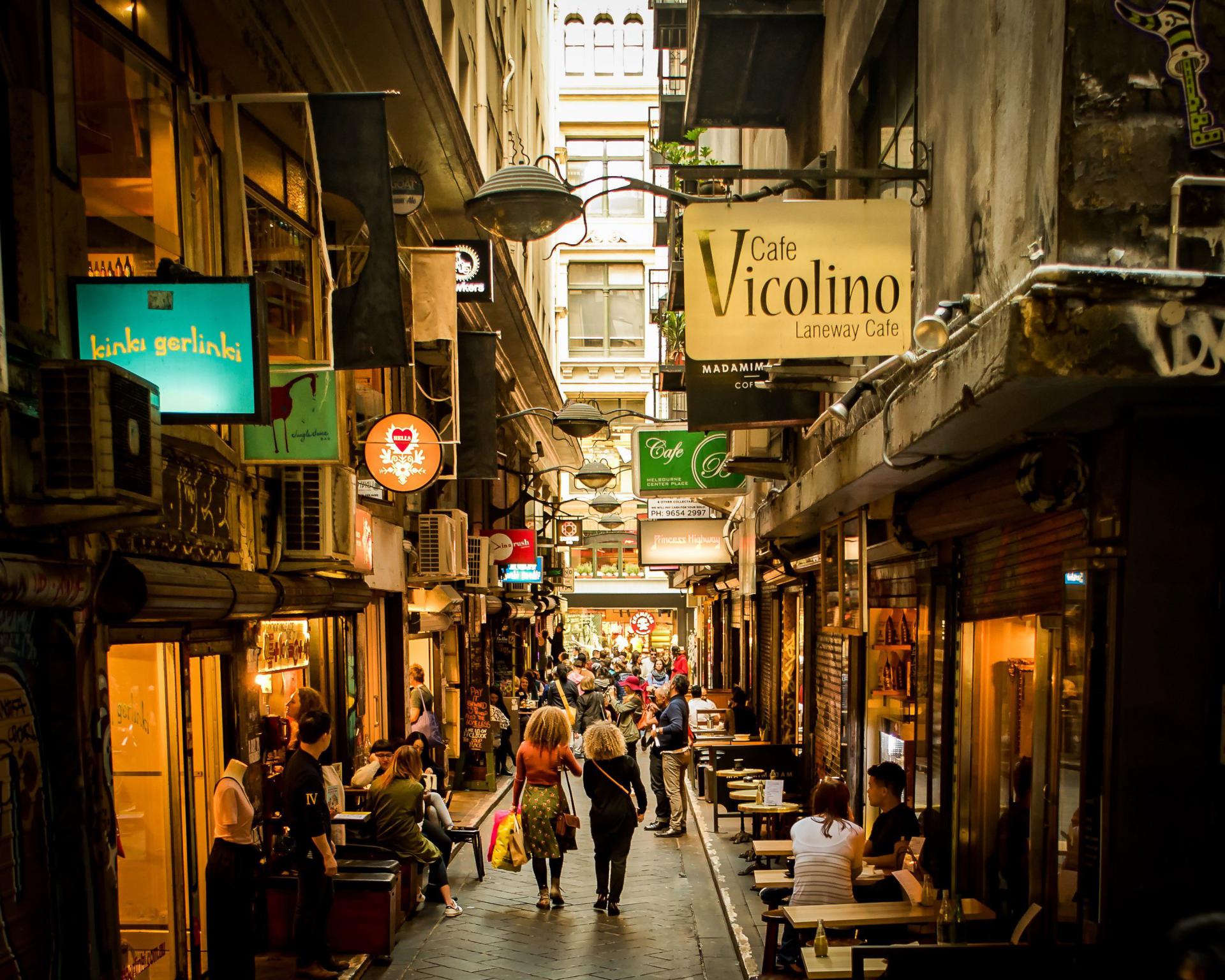
Melbourne’s laneways and arcades are part of the city’s identity, and the best way to see them is on foot. This walk strings together the highlights of the CBD: graffiti-covered lanes, rock’n’roll tributes, cobblestoned coffee strips and ornate Victorian arcades, with Flinders Street Station and Federation Square along the way.
You’ll pass tributes to famous Melburnians, including AC/DC, Dame Edna Everage and Divinyls singer Chrissy Amphlett, and a lane beside St Paul’s Cathedral with a long queer history. An arcade is simply a covered laneway, and the roofs range from plain glass to elaborate French Renaissance domes.
The main walk finishes in Hardware Lane, a good place for a meal or a drink. If you still have energy, three optional lanes add more street art and a few more local legends.




-
1City GuideA small laneway plastered with street art and gig posters, named after the wooden walkways laid over muddy World War I battlefields.Stop 1City Guide
Duckboard Place
A small laneway plastered with street art and gig posters, named after the wooden walkways laid over muddy World War I battlefields.Duckboard Place is a small laneway plastered with street art and gig posters. The area was a popular entertainment spot for World War II troops, and it takes its name from the duckboards, the paths of wooden slats laid over the mud of World War I battlefields.
Upmarket Indian restaurant Tonka is tucked away here if you want to come back for dinner.
Directions
Continue around the corner into AC/DC Lane.
-
2City GuideA rock’n’roll lane covered in tributes to AC/DC, including a sculpture of Bon Scott bursting out of the brickwork.Stop 2City Guide
AC/DC Lane
A rock’n’roll lane covered in tributes to AC/DC, including a sculpture of Bon Scott bursting out of the brickwork.AC/DC Lane is a graffiti-plastered, rock-themed laneway right next to Duckboard Place. In 1976 the band rode down nearby Swanston Street on a flatbed truck to film the clip for It’s a Long Way to the Top (If You Wanna Rock ’n’ Roll), and in 2004 the lane was renamed in their honour. Lord Mayor John So launched it by declaring that there may be a highway to hell, but this is a laneway to heaven.
Look for the giant tribute to guitarist Malcolm Young, painted after his death in 2017, and the 3D sculpture of singer Bon Scott breaking through the wall, unveiled in 2018. Other rock icons, such as Jimi Hendrix, appear along the walls too.
Cherry Bar
The lane’s rock theme came from Cherry Bar, a live music institution that inspired Jet’s Rollover DJ and drew visitors like Lady Gaga and Noel Gallagher. It left AC/DC Lane in 2019 and moved to Little Collins Street, but you’ll still spot references to it along the lane.
Directions
At the end of the lane, turn left and walk west along Flinders Lane, across Russell Street, then turn left into Hosier Lane.
-
3City GuideMelbourne’s most famous street art lane, an ever-changing canvas of colourful and often political work.Stop 3City Guide
Hosier Lane
Melbourne’s most famous street art lane, an ever-changing canvas of colourful and often political work.Possibly the most famous of Melbourne’s laneways, Hosier Lane is covered in striking, colourful street art. The walls are painted over so often that there’s no point listing individual works: look for political commentary, something Melbourne is known for, and you may even hear the rattle of a spray can as an artist adds to the canvas.
Don’t miss Rutledge Lane, which runs off Hosier Lane. Tapas favourite MoVida is here too.
Banksy was here
The lane once had a work by Banksy, until it was accidentally removed by the City of Melbourne.
Directions
At the Flinders Street end, turn right, then take the next right into Chapter House Lane, beside St Paul’s Cathedral.
-
4City GuideThe narrow lane beside St Paul’s Cathedral hides a long queer history: the Chapter House toilet was one of Melbourne’s longest-running beats.Stop 4City Guide
St Paul’s Cathedral and Chapter House Lane
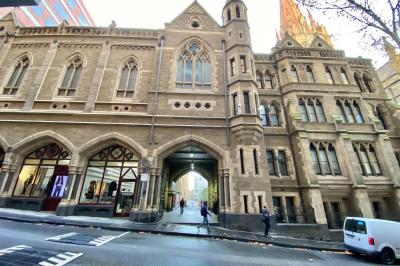
The narrow lane beside St Paul’s Cathedral hides a long queer history: the Chapter House toilet was one of Melbourne’s longest-running beats.Chapter House Lane squeezes between St Paul’s Cathedral and its Chapter House, linking Flinders Street with Flinders Lane. Take a moment to look up at the cathedral’s spires before you head on.
The Confessional
During World War II, a toilet in St Paul’s Chapter House became a beat known as “the Confessional”, and the lane beside the cathedral was nicknamed “the Wailing Wall”. It was one of Melbourne’s longest-running beats, in use from the 1860s to the 1990s.
The Chapter House also hosted the first meeting of Society Five, the Melbourne branch of the Campaign Against Moral Persecution (CAMP).
Directions
Follow the lane to Flinders Lane, turn left and cross Swanston Street. Cathedral Arcade is on the corner, on the ground floor of the Nicholas Building.
-
5City GuideA 1920s arcade roofed with a glowing leadlight ceiling and dome, in a building known as a vertical village of artists.Stop 5City Guide
Cathedral Arcade (Nicholas Building)
A 1920s arcade roofed with a glowing leadlight ceiling and dome, in a building known as a vertical village of artists.On the corner of Swanston Street and Flinders Lane, Cathedral Arcade runs through the ground floor of the Nicholas Building, designed by Harry Norris and completed in 1926. Look up: the arcade is roofed with stained glass and leadlights that arch towards a central dome.
The building above has long been known as a vertical artists’ village, home to galleries, designers, makers and small businesses.
Directions
Exit onto Swanston Street and turn right. At Flinders Street, Flinders Street Station and Federation Square face each other across the intersection.
-
6City GuideMelbourne’s most recognisable landmark, with Federation Square just across the road.Melbourne’s most recognisable landmark, with Federation Square just across the road.
With its dome, arched entrance, tower and clocks, Flinders Street Station is one of the city’s most recognisable landmarks. Across the road, Federation Square is the city’s public square, home to galleries, cafés and events, and a good spot for a break before heading back into the lanes.
Directions
Walk west along Flinders Street and turn right into Degraves Street.
-
7City GuideThe darling of Melbourne’s laneways: a narrow, car-free strip of cafés, restaurants and independent boutiques with a European feel.Stop 7City Guide
Degraves Street
The darling of Melbourne’s laneways: a narrow, car-free strip of cafés, restaurants and independent boutiques with a European feel.Degraves Street was one of the first Melbourne laneways to be revitalised, and it’s still one of the most loved. The narrow pedestrian-only street has a vibrant European feel and is lined with cafés, restaurants and artisan boutiques. Melbourne is proud of its independent stores, so you won’t find chains here.
It’s named after brothers Charles and William Degraves, merchants from Hobart who set up a flour mill in the area in 1849.
Directions
Take a slight right at the end and continue into Centre Place.
-
8City GuideA cobblestoned lane that sums up Melbourne: coffee, independent shops and street art.Stop 8City Guide
Centre Place
A cobblestoned lane that sums up Melbourne: coffee, independent shops and street art.Centre Place is another narrow, pedestrian-only lane, so close to Degraves Street that the two feel like one. It sums up several sides of the city’s culture: cobblestones, coffee, independent stores and street art.
Directions
Climb the steps at the end of Centre Place and walk through Centreway Arcade to Collins Street. Cross Collins Street, turn left, and turn right into the Block Arcade.
-
9City GuideMelbourne’s most ornate arcade, with French Renaissance arches, decorative tiles, a dome and a tea room that dates back to 1892.Stop 9City Guide
Block Arcade
Melbourne’s most ornate arcade, with French Renaissance arches, decorative tiles, a dome and a tea room that dates back to 1892.The Block Arcade is an elaborate French Renaissance-style arcade full of arches, cornices and decorative tiles, with a dome where its two wings meet. It’s lined with high-end boutiques and cafés, including The Tea Rooms 1892, on the site of the Hopetoun Tea Rooms, which served here from 1892 to 2020.
Leave by the Little Collins Street end through Block Place, a small lane of hole-in-the-wall cafés that’s perfect for a cosy breakfast or a quick lunch.
Doing the block
The arcade opened in 1892 and is named after the 19th-century custom of “doing the block”, when the city’s fashionable set dressed in their best and promenaded along Collins Street between Elizabeth and Swanston streets.
Directions
From Block Place, turn right along Little Collins Street. The next right is Dame Edna Place.
-
10City GuideA small lane named after Melbourne’s favourite housewife, Dame Edna Everage, and launched by ten Dame Edna look-alikes.Stop 10City Guide
Dame Edna Place
A small lane named after Melbourne’s favourite housewife, Dame Edna Everage, and launched by ten Dame Edna look-alikes.Melbourne’s favourite housewife, with her lilac hair and trademark glasses, has her own laneway. Formerly Brown Alley, this small dead-end lane off Little Collins Street was renamed Dame Edna Place in 2007. Dame Edna wasn’t at the ceremony, so ten look-alike Dames stood in.
Look for the marquee lights that light up the lane at night. Apart from those, it’s a plain back lane, but it’s a fitting nod to one of Australia’s great camp icons. Barry Humphries, the Melbourne-born comedian who created Dame Edna, died in 2023.
Directions
Cross Little Collins Street into the Royal Arcade.
-
11City GuideAustralia’s oldest surviving arcade, opened in 1870, where the giants Gog and Magog strike the hours.Stop 11City Guide
Royal Arcade
Australia’s oldest surviving arcade, opened in 1870, where the giants Gog and Magog strike the hours.Opened in 1870, the Royal Arcade is the oldest surviving arcade in Australia, lined with boutiques, cafés and vintage shops. Its best-known feature is at the Little Collins Street entrance: a large clock framed by statues of Gog and Magog, who strike the chimes each hour.
Gog and Magog
The figures were added in 1892 by Thomas Gaunt, a jeweller and clockmaker with a shop in the arcade. They’re modelled on the giants that watch over London’s Guildhall, who in legend were captured by the Trojans and made to serve as porters at a palace gate.
Directions
Exit the arcade onto Bourke Street, turn left and walk west, crossing Elizabeth Street. Hardware Lane is on the right, about halfway to Queen Street.
-
12City GuideA red-brick lane of alfresco restaurants and bars, and the end of the main walk.Stop 12City Guide
Hardware Lane
A red-brick lane of alfresco restaurants and bars, and the end of the main walk.Hardware Lane is a narrow red-brick lane lined with alfresco dining and specialty shops, another standout of Melbourne’s laneway revival. Think of it as an upmarket, sunnier take on grittier lanes like Degraves Street: no graffiti or dumpsters, just tables spilling into the lane.
This is the end of the main walk, so it’s a good time to stop for a meal or a drink. If you’re keen for more, carry on to the three optional lanes.
Directions
Walk back east along Bourke Street, cross Elizabeth Street into the Bourke Street Mall and turn right into Union Lane.
-
13City GuideA long street art lane that’s usually much quieter than Hosier Lane.OptionalOptional stop 13City Guide
Union Lane
A long street art lane that’s usually much quieter than Hosier Lane.Named after a long-gone pub, Union Lane became an open-air canvas through a City of Melbourne street art project in 2008, with around 550 square metres of walls to cover. If the crowds kept you from getting the perfect shot in Hosier Lane, this is a quieter alternative.
Directions
Follow the lane to Little Collins Street, turn left and cross Swanston Street. Rainbow Alley is on the left.
-
14City GuideA tiny lane off Little Collins Street, named before 1856 after the long-gone Rainbow Hotel.OptionalOptional stop 14City Guide
Rainbow Alley
A tiny lane off Little Collins Street, named before 1856 after the long-gone Rainbow Hotel.Rainbow Alley runs off Little Collins Street between Swanston and Russell streets. The name has nothing to do with Pride: it dates from before 1856 and comes from the Rainbow Hotel, which stood on the corner of Swanston and Little Collins streets. It’s still hard to resist a photo with the sign.
The lane is one of the sites of Flash Forward, a City of Melbourne program that commissioned new artworks for the city’s laneways.
Directions
Continue east along Little Collins Street to Exhibition Street, turn left and walk two blocks to Little Bourke Street. Turn right; Amphlett Lane is near the Spring Street end, behind the Princess Theatre.
-
15City GuideA lane behind the Princess Theatre named after Divinyls singer Chrissy Amphlett, with a mural and plaque at the entrance.OptionalOptional stop 15City Guide
Amphlett Lane
A lane behind the Princess Theatre named after Divinyls singer Chrissy Amphlett, with a mural and plaque at the entrance.Amphlett Lane honours Chrissy Amphlett, the fierce frontwoman of the Divinyls, best known for I Touch Myself and Pleasure and Pain. The lane sits behind the Princess Theatre and the former Palace Theatre: she played the Palace with the Divinyls and starred in The Boy From Oz at the Princess in 1999.
Fans campaigned for the name with a petition of more than 7,000 signatures, and the lane was opened in 2015, two years after she died. Look for the mural and memorial plaque at the entrance.
-
1City GuideA small laneway plastered with street art and gig posters, named after the wooden walkways laid over muddy World War I battlefields.Stop 1City Guide
Duckboard Place
A small laneway plastered with street art and gig posters, named after the wooden walkways laid over muddy World War I battlefields.Duckboard Place is a small laneway plastered with street art and gig posters. The area was a popular entertainment spot for World War II troops, and it takes its name from the duckboards, the paths of wooden slats laid over the mud of World War I battlefields.
Upmarket Indian restaurant Tonka is tucked away here if you want to come back for dinner.
-
2City GuideA rock’n’roll lane covered in tributes to AC/DC, including a sculpture of Bon Scott bursting out of the brickwork.Stop 2City Guide
AC/DC Lane
A rock’n’roll lane covered in tributes to AC/DC, including a sculpture of Bon Scott bursting out of the brickwork.AC/DC Lane is a graffiti-plastered, rock-themed laneway right next to Duckboard Place. In 1976 the band rode down nearby Swanston Street on a flatbed truck to film the clip for It’s a Long Way to the Top (If You Wanna Rock ’n’ Roll), and in 2004 the lane was renamed in their honour. Lord Mayor John So launched it by declaring that there may be a highway to hell, but this is a laneway to heaven.
Look for the giant tribute to guitarist Malcolm Young, painted after his death in 2017, and the 3D sculpture of singer Bon Scott breaking through the wall, unveiled in 2018. Other rock icons, such as Jimi Hendrix, appear along the walls too.
Cherry Bar
The lane’s rock theme came from Cherry Bar, a live music institution that inspired Jet’s Rollover DJ and drew visitors like Lady Gaga and Noel Gallagher. It left AC/DC Lane in 2019 and moved to Little Collins Street, but you’ll still spot references to it along the lane.
-
3City GuideMelbourne’s most famous street art lane, an ever-changing canvas of colourful and often political work.Stop 3City Guide
Hosier Lane
Melbourne’s most famous street art lane, an ever-changing canvas of colourful and often political work.Possibly the most famous of Melbourne’s laneways, Hosier Lane is covered in striking, colourful street art. The walls are painted over so often that there’s no point listing individual works: look for political commentary, something Melbourne is known for, and you may even hear the rattle of a spray can as an artist adds to the canvas.
Don’t miss Rutledge Lane, which runs off Hosier Lane. Tapas favourite MoVida is here too.
Banksy was here
The lane once had a work by Banksy, until it was accidentally removed by the City of Melbourne.
-
4City GuideThe narrow lane beside St Paul’s Cathedral hides a long queer history: the Chapter House toilet was one of Melbourne’s longest-running beats.Stop 4City Guide
St Paul’s Cathedral and Chapter House Lane
The narrow lane beside St Paul’s Cathedral hides a long queer history: the Chapter House toilet was one of Melbourne’s longest-running beats.Chapter House Lane squeezes between St Paul’s Cathedral and its Chapter House, linking Flinders Street with Flinders Lane. Take a moment to look up at the cathedral’s spires before you head on.
The Confessional
During World War II, a toilet in St Paul’s Chapter House became a beat known as “the Confessional”, and the lane beside the cathedral was nicknamed “the Wailing Wall”. It was one of Melbourne’s longest-running beats, in use from the 1860s to the 1990s.
The Chapter House also hosted the first meeting of Society Five, the Melbourne branch of the Campaign Against Moral Persecution (CAMP).
-
5City GuideA 1920s arcade roofed with a glowing leadlight ceiling and dome, in a building known as a vertical village of artists.Stop 5City Guide
Cathedral Arcade (Nicholas Building)
A 1920s arcade roofed with a glowing leadlight ceiling and dome, in a building known as a vertical village of artists.On the corner of Swanston Street and Flinders Lane, Cathedral Arcade runs through the ground floor of the Nicholas Building, designed by Harry Norris and completed in 1926. Look up: the arcade is roofed with stained glass and leadlights that arch towards a central dome.
The building above has long been known as a vertical artists’ village, home to galleries, designers, makers and small businesses.
-
6City GuideMelbourne’s most recognisable landmark, with Federation Square just across the road.Stop 6City Guide
Flinders Street Station
Melbourne’s most recognisable landmark, with Federation Square just across the road.With its dome, arched entrance, tower and clocks, Flinders Street Station is one of the city’s most recognisable landmarks. Across the road, Federation Square is the city’s public square, home to galleries, cafés and events, and a good spot for a break before heading back into the lanes.
-
7City GuideThe darling of Melbourne’s laneways: a narrow, car-free strip of cafés, restaurants and independent boutiques with a European feel.Stop 7City Guide
Degraves Street
The darling of Melbourne’s laneways: a narrow, car-free strip of cafés, restaurants and independent boutiques with a European feel.Degraves Street was one of the first Melbourne laneways to be revitalised, and it’s still one of the most loved. The narrow pedestrian-only street has a vibrant European feel and is lined with cafés, restaurants and artisan boutiques. Melbourne is proud of its independent stores, so you won’t find chains here.
It’s named after brothers Charles and William Degraves, merchants from Hobart who set up a flour mill in the area in 1849.
-
8City GuideA cobblestoned lane that sums up Melbourne: coffee, independent shops and street art.Stop 8City Guide
Centre Place
A cobblestoned lane that sums up Melbourne: coffee, independent shops and street art.Centre Place is another narrow, pedestrian-only lane, so close to Degraves Street that the two feel like one. It sums up several sides of the city’s culture: cobblestones, coffee, independent stores and street art.
-
9City GuideMelbourne’s most ornate arcade, with French Renaissance arches, decorative tiles, a dome and a tea room that dates back to 1892.Stop 9City Guide
Block Arcade
Melbourne’s most ornate arcade, with French Renaissance arches, decorative tiles, a dome and a tea room that dates back to 1892.The Block Arcade is an elaborate French Renaissance-style arcade full of arches, cornices and decorative tiles, with a dome where its two wings meet. It’s lined with high-end boutiques and cafés, including The Tea Rooms 1892, on the site of the Hopetoun Tea Rooms, which served here from 1892 to 2020.
Leave by the Little Collins Street end through Block Place, a small lane of hole-in-the-wall cafés that’s perfect for a cosy breakfast or a quick lunch.
Doing the block
The arcade opened in 1892 and is named after the 19th-century custom of “doing the block”, when the city’s fashionable set dressed in their best and promenaded along Collins Street between Elizabeth and Swanston streets.
-
10City GuideA small lane named after Melbourne’s favourite housewife, Dame Edna Everage, and launched by ten Dame Edna look-alikes.Stop 10City Guide
Dame Edna Place
A small lane named after Melbourne’s favourite housewife, Dame Edna Everage, and launched by ten Dame Edna look-alikes.Melbourne’s favourite housewife, with her lilac hair and trademark glasses, has her own laneway. Formerly Brown Alley, this small dead-end lane off Little Collins Street was renamed Dame Edna Place in 2007. Dame Edna wasn’t at the ceremony, so ten look-alike Dames stood in.
Look for the marquee lights that light up the lane at night. Apart from those, it’s a plain back lane, but it’s a fitting nod to one of Australia’s great camp icons. Barry Humphries, the Melbourne-born comedian who created Dame Edna, died in 2023.
-
11City GuideAustralia’s oldest surviving arcade, opened in 1870, where the giants Gog and Magog strike the hours.Stop 11City Guide
Royal Arcade
Australia’s oldest surviving arcade, opened in 1870, where the giants Gog and Magog strike the hours.Opened in 1870, the Royal Arcade is the oldest surviving arcade in Australia, lined with boutiques, cafés and vintage shops. Its best-known feature is at the Little Collins Street entrance: a large clock framed by statues of Gog and Magog, who strike the chimes each hour.
Gog and Magog
The figures were added in 1892 by Thomas Gaunt, a jeweller and clockmaker with a shop in the arcade. They’re modelled on the giants that watch over London’s Guildhall, who in legend were captured by the Trojans and made to serve as porters at a palace gate.
-
12City GuideA red-brick lane of alfresco restaurants and bars, and the end of the main walk.Stop 12City Guide
Hardware Lane
A red-brick lane of alfresco restaurants and bars, and the end of the main walk.Hardware Lane is a narrow red-brick lane lined with alfresco dining and specialty shops, another standout of Melbourne’s laneway revival. Think of it as an upmarket, sunnier take on grittier lanes like Degraves Street: no graffiti or dumpsters, just tables spilling into the lane.
This is the end of the main walk, so it’s a good time to stop for a meal or a drink. If you’re keen for more, carry on to the three optional lanes.
-
13City GuideA long street art lane that’s usually much quieter than Hosier Lane.OptionalOptional stop 13City Guide
Union Lane
A long street art lane that’s usually much quieter than Hosier Lane.Named after a long-gone pub, Union Lane became an open-air canvas through a City of Melbourne street art project in 2008, with around 550 square metres of walls to cover. If the crowds kept you from getting the perfect shot in Hosier Lane, this is a quieter alternative.
-
14City GuideA tiny lane off Little Collins Street, named before 1856 after the long-gone Rainbow Hotel.OptionalOptional stop 14City Guide
Rainbow Alley
A tiny lane off Little Collins Street, named before 1856 after the long-gone Rainbow Hotel.Rainbow Alley runs off Little Collins Street between Swanston and Russell streets. The name has nothing to do with Pride: it dates from before 1856 and comes from the Rainbow Hotel, which stood on the corner of Swanston and Little Collins streets. It’s still hard to resist a photo with the sign.
The lane is one of the sites of Flash Forward, a City of Melbourne program that commissioned new artworks for the city’s laneways.
-
15City GuideA lane behind the Princess Theatre named after Divinyls singer Chrissy Amphlett, with a mural and plaque at the entrance.OptionalOptional stop 15City Guide
Amphlett Lane
A lane behind the Princess Theatre named after Divinyls singer Chrissy Amphlett, with a mural and plaque at the entrance.Amphlett Lane honours Chrissy Amphlett, the fierce frontwoman of the Divinyls, best known for I Touch Myself and Pleasure and Pain. The lane sits behind the Princess Theatre and the former Palace Theatre: she played the Palace with the Divinyls and starred in The Boy From Oz at the Princess in 1999.
Fans campaigned for the name with a petition of more than 7,000 signatures, and the lane was opened in 2015, two years after she died. Look for the mural and memorial plaque at the entrance.